Britain recognised Somaliland as a sovereign state on 26 June 1960. That recognition was formal, binding, and grounded in treaties that made one point explicit. Britain could not dispose of Somaliland's sovereignty without its consent.
A few months later, it did exactly that.
The UK unilaterally told the UN that Somaliland and Somalia had 'mutually agreed' to unite. That claim collapses on the facts. There was no Act of Union, no ratification in Hargeisa, no free and fair referendum, and the Mogadishu text never gained legal force. What the world calls a union was nothing more than a political assumption dressed up as law. In this article I explore whether this was an honest mistake or simply a continuation of the UK's colonial misconduct toward Somaliland.
Why Britain Broke Its Own Commitments
The reasons were simple, and none of them legal.
London wanted administrative convenience. Two new governments in the Horn were seen as an unnecessary workload. One file was easier than two. Bureaucratic neatness outweighed treaty obligations.
British officials also feared that Somaliland was not economically viable. They warned of creating 'two beggar states instead of one'. This was a colonial judgement, not law. Sovereignty is not conditional on a territory's GDP. The treaties Britain signed did not allow London to override Somaliland's consent because of its own economic anxieties.
Five years earlier, Britain had already transferred a third of Somaliland's grazing lands to Ethiopia through the 1954 Anglo Ethiopian Agreement, again without consent. The pattern was the same. Somaliland's rights traded away for British convenience.
The Diplomatic Error That Still Shapes Policy
Modern governments treat Somaliland as part of Somalia because they assume that the 1960 "union" was lawful. It was not.
International law requires mutual consent, parliamentary ratification, and clear legal terms. None of that occurred. Somalilanders rejected the new Somali constitution in the 1961 referendum. Northern officers attempted to restore independence months later. The "union" lacked legitimacy from the start.
Yet the world still clings to this fiction. Terms like 'territorial integrity' hide the fact that there was never a lawful unification to protect.
The Historical Irony
Everything Britain feared has been proven wrong.
Somaliland built a functioning democracy. It held competitive elections, changed leaders peacefully, and resolved disputes through courts.
It funds its own government. No recognition, no peacekeepers, no direct budget support, yet it maintains order and runs institutions.
It is more stable than the state it was tied to. Somalia has struggled through decades of civil war and terrorism despite massive international investment. Somaliland achieved stability on its own.
The state doubted in 1960 succeeded. The state it was allegedly "merged" with has not.
The Case for Recognition
Recognising Somaliland is not a favour. It is a correction. Somaliland is not seceding from Somalia. It is resuming a sovereignty that predates the attempted "union".
The legal facts are clear. The historical record is clear. The performance on the ground is clear. What remains is political honesty. Governments can continue repeating a colonial era mistake or they can acknowledge what the law and evidence already show.
The question is not whether Somaliland is a state. It is whether the world is prepared to admit that it always was.
A Note on the Image
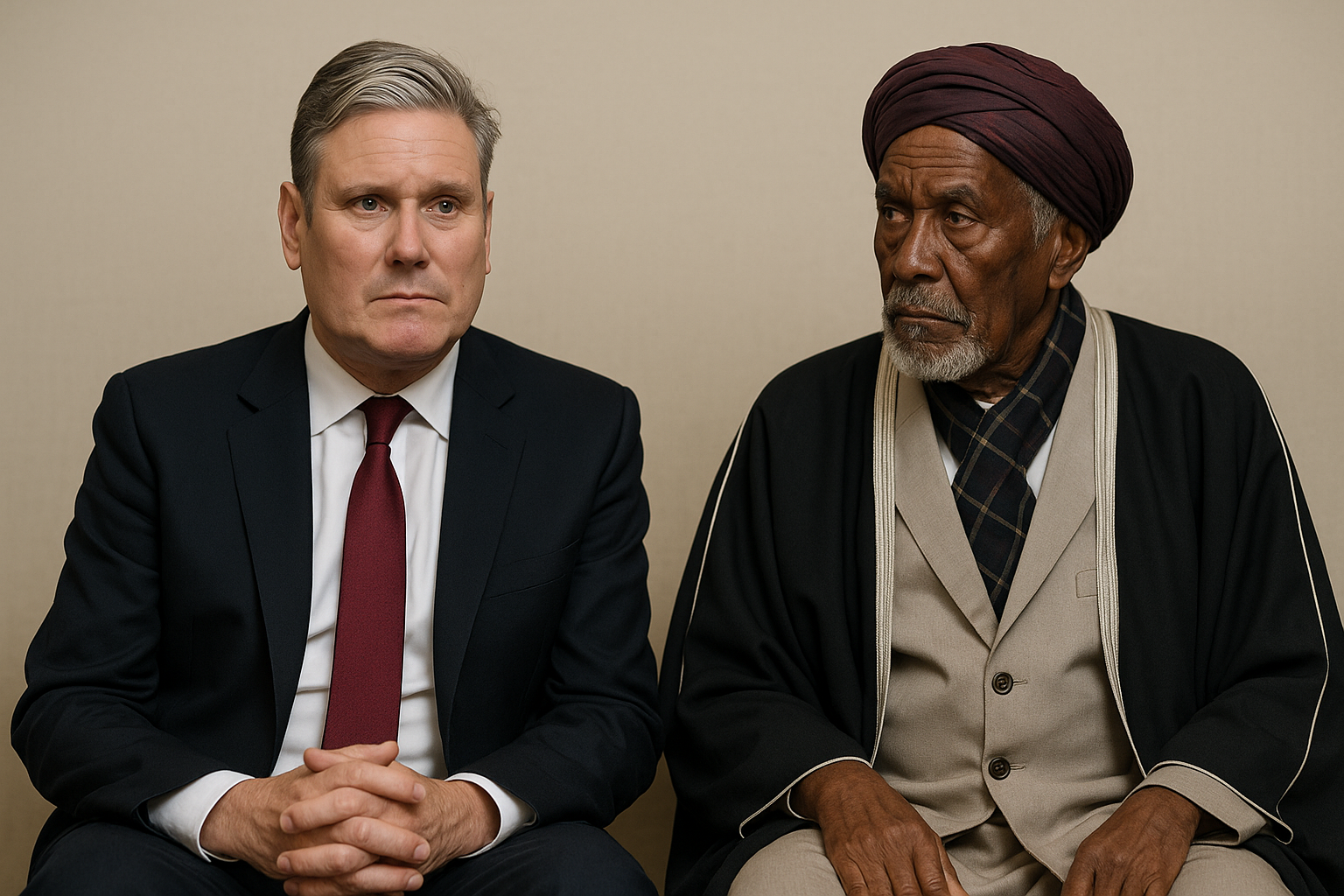
A moment across time: The current UK Prime Minister meeting with Sultan Abdillahi Sultan Deria, one of Somaliland elders who led a delegation to London in the 1950s to protest the transfer of the Haud and Reserved Areas to Ethiopia without Somaliland's consent.(AI generated)
This imaginative rendering bridges seventy years of British policy towards Somaliland. It visualises the conversation that should have happened then, and must happen now. The Sultan came seeking justice. Modern Britain still owes an answer. Nothing has changed.