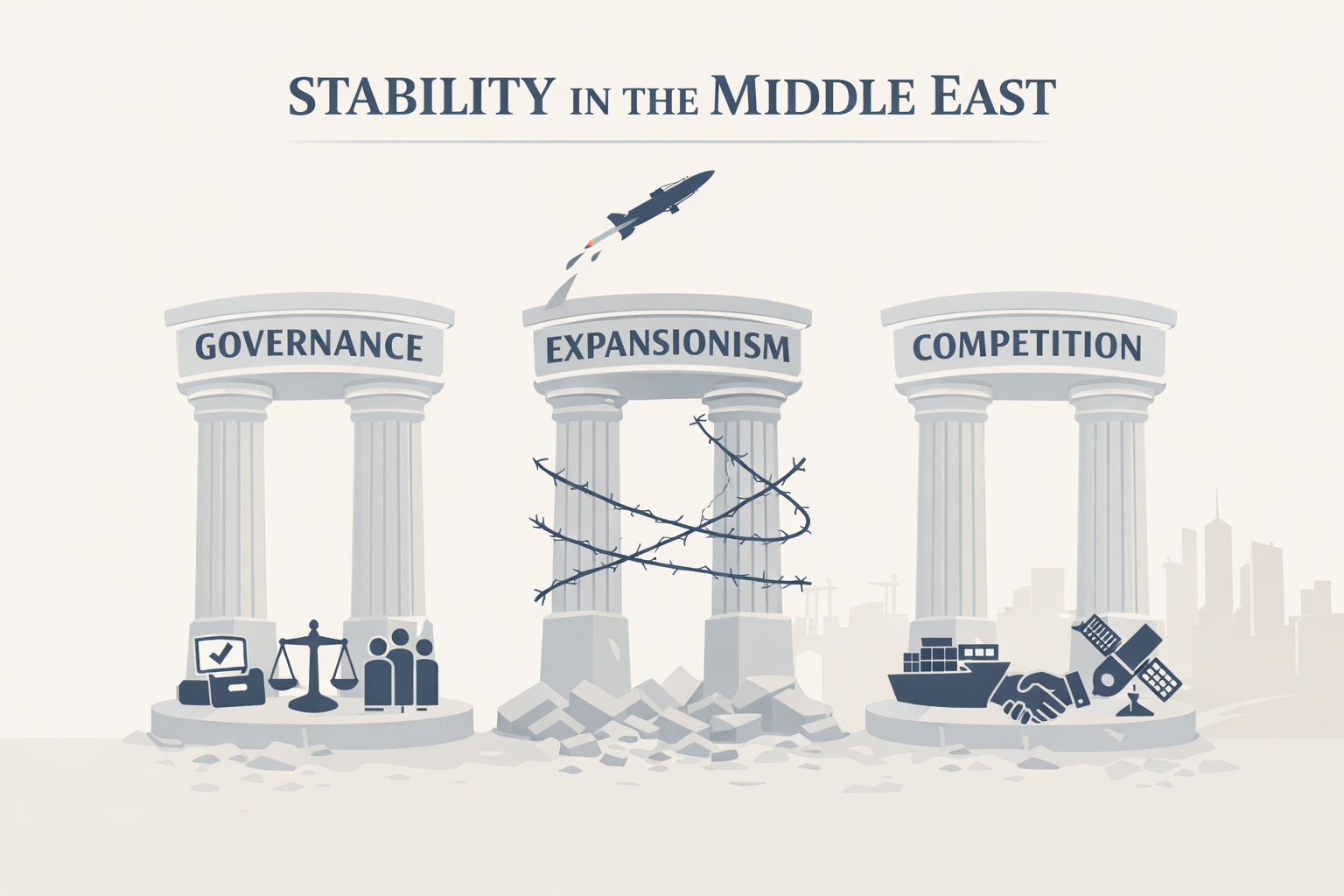
War with Iran will not stabilise the Middle East. Stability depends on rejecting expansionism, improving internal governance, and allowing peaceful competition between regional frameworks.
The current conflict is being treated as decisive. It is not. Even a weakened Iran would not resolve the region’s underlying drivers of instability. State fragility, governance failure, and competing political systems continue to generate conflict independently of Iranian influence.
A realist framework rests on three principles: rejection of expansionism, development of accountable governance, and acceptance of structured competition between regional approaches.
Expansionism and State Boundaries
The international system depends on the preservation of state boundaries at the time of independence. Efforts to alter those boundaries or impose transnational political identities produce instability.
In practice, expansionism is observable. Iran projects influence through proxy networks across multiple states. Somali irredentism challenges African colonial borders through the concept of a “Greater Somalia.”
By contrast, claims of Israeli expansionism are not supported by consistent operational evidence. Israeli policy has been primarily security-driven, and precedent shows willingness to exchange territory for recognised agreements, including the return of Sinai to Egypt. Framing Israel as expansionist obscures the distinction between narrative and behaviour.
A stable order requires clear identification of actual expansionism.
Transnational expansionism can operate through ideological networks rather than states. Movements associated with the Muslim Brotherhood illustrate this. Islamic political parties confined within national borders can be a normal and tolerable expression of domestic democratic choice. However, when leadership, religious authorities, and economic networks coordinate across borders toward a unified political project, the result becomes expansionist. Across North Africa and the Horn of Africa, elements within these networks promote forms of integration that challenge the state-based order, including visions aligned with a broader caliphate. This places them within the category of expansionist ideologies that should be collectively rejected.
Governance as the Core Constraint
Regional instability is sustained by internal governance failures as much as external interference.
Lebanon, Syria, South Sudan and Sudan demonstrate that institutional weakness and lack of accountability can produce prolonged instability without a single dominant external cause.
Systems that cannot adapt internally degrade over time. Governance structures must enable participation, correction, and legitimacy, whether through democratic or locally grounded consultative systems.
Misaligned Intervention and Fragmentation
External intervention that overrides local political dynamics produces fragmentation rather than stability.
In southern Yemen, Saudi military actions against UAE-backed local forces have fractured the anti-Houthi camp, weakening governance formation and indirectly strengthening more cohesive actors, including the Houthis.
Where peaceful competition is replaced by coercion, fragmentation follows.
Limits of Military Pressure
Military action can constrain actors but cannot resolve structural weaknesses.
This is why the Iran war should end now. What has already occurred may produce limited, second-order stabilising effects.
Continued IRGC activity creates a clear incentive for Gulf states to reduce internal competition and align against a shared threat. A weakened Iran can claim a symbolic “victory,” lowering the likelihood of escalation cycles, including retaliation against Israel following the Gaza war. This creates space for renewed Arab–Israeli reconciliation, limiting the ability of Iran and non-state actors to exploit unresolved conflicts.
U.S. actions have also degraded Iran’s military and nuclear capabilities in measurable ways. However, long-term change within Iran will depend on internal evolution rather than external pressure.
If the war resumes and leads to state collapse, the outcome is unlikely to be stability. Instead, fragmentation would emerge (including multiple IRGC-type factions) alongside increased risks to critical routes such as the Strait of Hormuz and Gulf energy infrastructure.
Overall, the assumption that weakening one actor will stabilise the region does not reflect the actual distribution of risk.
Competitive Regional Frameworks
The region is moving toward overlapping and flexible alignments rather than fixed blocs.
One framework is forming around the United States, Israel, the United Arab Emirates, and aligned partners. It prioritises state stability, economic coordination, and controlled political development. Somaliland fits within this framework as a functioning example of state continuity, locally grounded governance, and strategic alignment without expansionism.
Other actors, including Turkey and Pakistan, are advancing alternative political approaches. Saudi Arabia operates independently, aligning selectively while competing for influence.
These dynamics are not inherently destabilising. Structured competition allows different models to be tested through outcomes rather than imposed through force.
Reframing Iran
Iran is one actor within a broader regional system. Its influence is significant but not determinative.
External regime change is unlikely to produce durable outcomes. Internal change, shaped by comparative performance, is more plausible over time.
Limiting Iran’s influence depends as much on the success of alternative models as on direct confrontation.
Israel and the Palestinian Question
Israel’s position is central to regional alignment.
Resolving the Palestinian question has direct strategic consequences. It reduces the legitimacy of jihadist narratives and removes a primary justification used by Iran to expand influence through proxy networks.
Without this issue, the ability of non-state actors and external powers to mobilise support across the region is significantly reduced.
This is a structural constraint on instability, not a secondary issue.
Conclusion
The war with Iran does not resolve the region’s core problems.
Stability requires rejection of expansionism, the development of governance systems capable of internal adaptation, and the acceptance of peaceful competition between regional frameworks.
Military action can degrade capabilities, but it does not produce order. In some cases, it reinforces instability and strengthens the incentives it seeks to eliminate.
For the United States, the question is also one of historical legacy.
President Donald Trump may seek to be remembered as the leader who destroyed Iran’s capabilities or prevented it from acquiring a nuclear weapon. That is a measurable outcome, but a limited one.
A more consequential legacy would be the construction of a regional order that is self-correcting, reduces incentives for expansion, and limits the need for repeated military intervention.
Such an order would not depend on continuous force. It would allow competing systems to operate within legal and factual boundaries, with stability emerging from performance rather than coercion.
The region will not stabilise when one actor is defeated.
It will stabilise when a system proves it can govern effectively, resolve conflicts, and sustain legitimacy without dependence on any single actor.