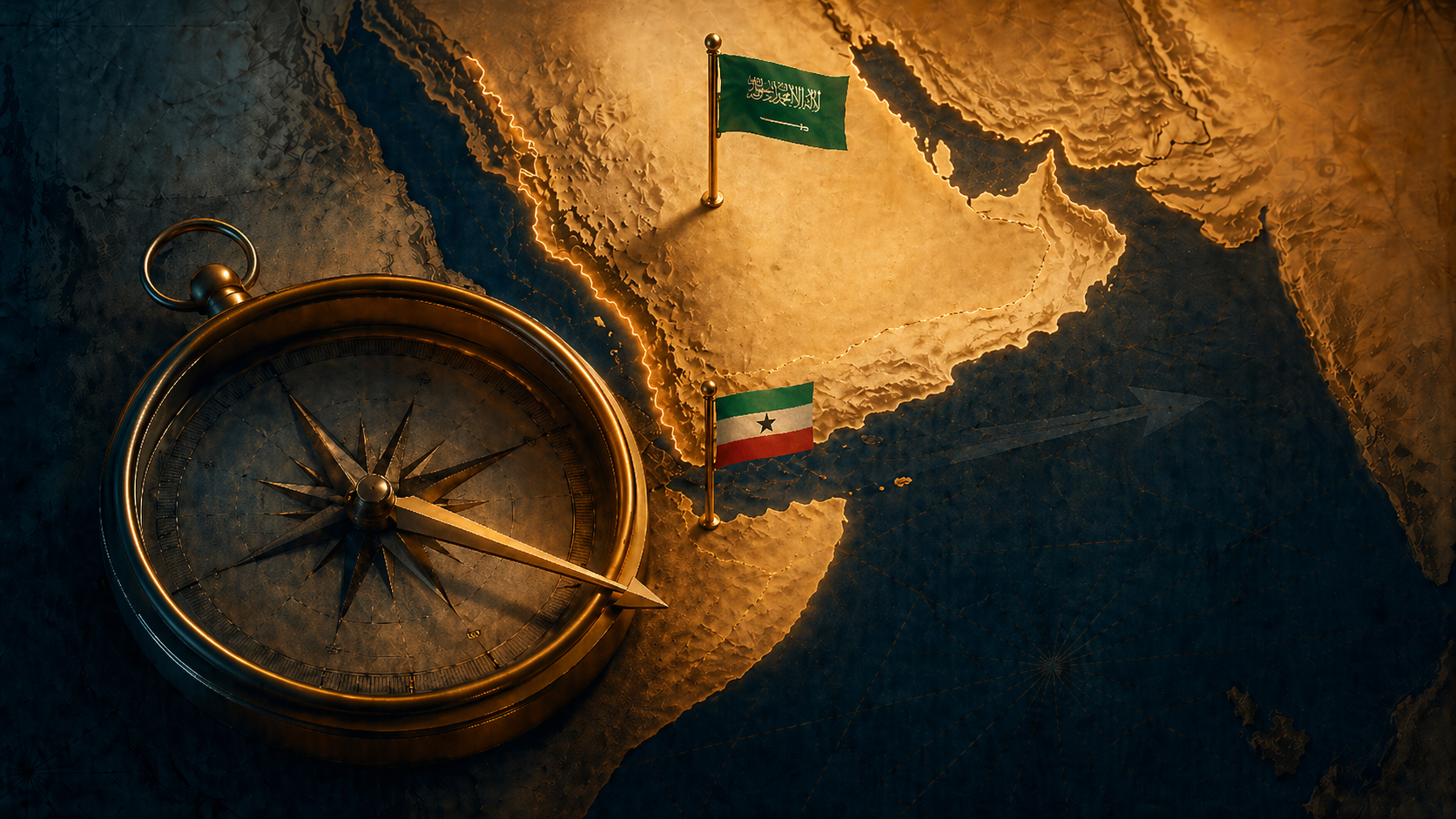
The Somaliland issue is not a sudden crisis that began with Israeli recognition, nor is it merely a legal dispute between Hargeisa and Mogadishu over the interpretation of “territorial integrity.” It is, in fact, an issue older than the modern Somali state itself, and deeper than the diplomatic statements that reduce it to the word “secession.” It is also a strategic opportunity for the Arabs, led by Saudi Arabia, if it is understood well before it becomes a permanent sphere of influence for others.
When Israel recognized Somaliland in December 2025, several Arab and Islamic capitals treated the event as if it were the beginning of the crisis. But Israeli recognition did not create Somaliland. What it did was expose an Arab and Islamic vacuum that extended for more than three decades. Somaliland was not established by an Israeli decision, nor did it build its institutions through Tel Aviv, nor did it obtain its historical borders from a hasty deal. It existed as a political and historical entity much earlier.
Hence, the most important question is not: Why did Israel recognize it? Rather: Why was Somaliland left in the first place to seek recognition from Israel as a last resort?
The real beginning
To understand Somaliland, we must go back to 1884, not just 1991. In that year, Britain began to extend its official influence over what was later known as British Somaliland, after the region passed from Egyptian and Ottoman administration to British influence. Historical references indicate that the northern coast of the Horn of Africa was in the nineteenth century within the Ottoman and Egyptian space, while the southern coast, that is, the areas of later Italian Somalia, was connected to the Omani space of Zanzibar and its commercial and political influence.
This difference is not a marginal detail. Before direct European colonization, Somaliland and subsequent Italian Somalia were not a single political entity. There were ethnic, religious and cultural ties between the Somali people, yes, but cultural ties did not necessarily mean the unity of the country. The Arabs themselves share a language, religion, and history, yet they live in multiple countries with different borders and different political experiences.
Before the Ottoman and Omani period, it can also be noted that the historical formations in the north and south differed. Somaliland was historically linked to the Sultanate of Adal, whose historical center was in Zeila and its environs, while southern Somaliland was linked to the Ajuran Sultanate, whose influence was connected to Mogadishu, Shabelle, Juba, and the centers of the southern coast.
The purpose of this narrative is not to say that history alone determines recognition. But it proves that talking about “one Somalia” as an eternal political truth is a gross simplification. There is a broad Somali people, but there are also different political experiences: Somaliland, Italian Somalia, Djibouti, and the Somali regions of Ethiopia and Kenya. Race alone is not enough to create a state. I discussed this logic in greater detail in The Union That Never Existed.
From the protectorate to the state
After decades of British protection, Somaliland gained independence on June 26, 1960 as the "State of Somaliland." A few days later, it entered into unity with the region that was under Italian guardianship to form the Somali Republic on July 1, 1960. This point is fundamental: Somaliland was not a province that separated from a state, but rather it was a short-lived state that entered into a voluntary political unity and later saw that that unity failed.
When the Somali central state collapsed in 1991, Somaliland was not creating an identity out of thin air, but rather declared the restoration of its independence based on the borders of the former British Somaliland and the experience of the state that preceded unification. This does not mean that the world is legally obligated to recognize it immediately, but it does mean that describing it as only a “separatist movement” is incomplete, and perhaps misleading. As I explained in Somaliland Declaration of State Continuity, there is a big difference between dividing an existing and stable state, and ending a failed unity project between two entities that were historically and administratively independent before unification.
Not every return is a breakup
Arab history itself knows similar cases in their general logic. Syria joined Egypt in the United Arab Republic in 1958, then withdrew from that unit in 1961, and returned to its independent political personality. The world did not deal with Syria as a “separatist entity” outside of legitimacy, but rather dealt with it as a country that returned to its previous status after the failure of political unity.
This example does not match Somaliland in every detail, but it raises a legitimate question: Why is Syria’s return to unity understood as a restoration of the state, while Somaliland’s return to failed unity is understood as an existential threat to the regional order?
Then the Arab and Islamic world accepted the independence of Djibouti, which was formerly French Somalia, even though it was part of the Somali ethnic and cultural space. If French Somalia has become an independent state, and if Italian Somalia has become the center of the recognized state in Mogadishu, why is British Somaliland alone required to remain a prisoner of a unit that has practically ceased to exist for more than three decades? This is what I addressed in more depth in The Misapplication of the Principle of Territorial Integrity.
This is not a call to destroy states, but rather a call for consistency of principle. Either we reject all colonial borders, which is practically impossible because it will overturn the entire Arab and African system, or we deal with the inherited borders as the basis of the modern international system. In this case, Somaliland alone cannot be excluded.
Beautiful slogan, more complex reality
Politics is not built on dreams alone. There are Somalis in Somalia, Somalis in Djibouti, Somalis in Ethiopia, Somalis in Kenya, and Somalis in Somaliland. The unity of the race does not necessarily mean the unity of the state.
If the criterion for a state were ethnic affiliation, the entire Arab world would be required to redraw its maps. Did the Arabs unite the Levant? Did they unite the Gulf? Did they unite the Arab Maghreb? If the Arab unity experiments themselves have failed or faltered, then why should Somaliland alone be asked to bear the burden of a failed unity forever?
Moreover, a united Somalia, in its political sense, no longer exists on the ground since the collapse of the central state. Mogadishu itself is still struggling to build full authority in its country, while Somaliland has built its institutions away from chaos. Ignoring this reality does not create unity, but rather creates a costly illusion.
Do not punish stability
It is a painful irony that Somaliland is being punished for its relative success. In a regional environment riven by civil wars, coups, militias, and external interventions, Somaliland has maintained a measure of security, institutions, elections, and local deliberation. However, it remained deprived of recognition, international financing, diplomatic presence, and full development opportunities. As I detailed in Somaliland Deserves Tens of Billions in Compensation, the price of isolation paid by this community cannot be measured by diplomatic statements.
The boycott does not only punish politicians. It punishes students, patients, merchants, farmers, youth, women, universities, and ports. It punishes an entire Muslim community because it chose to settle in a region accustomed to chaos.
Here a moral and strategic question arises: Is it wise for the Arabs to punish six million stable Muslims because they no longer believe in a unity that has practically failed for decades?
Recognition is not a sacred text
International recognition is not a fixed text that does not change. It is a legal and political position that changes as facts change. Saudi Arabia itself, like other countries, has dealt throughout its history with countries that emerged from unitary contexts or complex independence disputes. It recognized Bangladesh after its separation from Pakistan, and recognized Kosovo in 2009, which is one of the most sensitive cases in modern international law. As I wrote in State Recognition Is Not a Group Order, the absolute argument that Saudi Arabia does not recognize entities emerging from former states is not accurate.
This does not mean that Somaliland's situation is identical to Bangladesh, Kosovo or Eritrea. Every case has its circumstances. But it means that international politics is more complex than absolute rules, and Saudi policy itself has proven that it is capable of dealing with facts when they become stronger than denial.
Therefore, the real question is not: Are there precedents? The precedents are there. The question is: Has Somaliland reached a level of stability, institutionalization, and strategic location that makes engaging with it more beneficial than isolating it?
The answer, from the perspective of Saudi interest, clearly tends to be yes.
Law and reality
The theory of the state in international law, according to the classical formulation of the Montevideo Criteria, is based on well-known elements: a permanent population, a defined territory, a government, and the ability to enter into relations with other states.
Somaliland has a permanent population, a defined territory based on the borders of former British Somaliland, an established government, security and administrative institutions, and an increasing ability to build external relations. Although it is not widely recognized internationally, the lack of recognition has not prevented it from building a relatively stable political reality in a turbulent region.
Here the great paradox appears: many countries in the region are fully recognized, but they are unable to impose their sovereignty outside narrow areas of the capital, the airport, or protected hotels. In contrast, Somaliland is not recognized, but it has actual authority on the ground, a cohesive political community, and local institutions that are more established than governments that have international seats but do not have sufficient internal legitimacy.
This is precisely what should concern the Saudi decision-maker.
Functioning governments
It is in Saudi Arabia's interest, as a major regional power, to deal with functioning governments that have internal legitimacy, and not to base its policy solely on governments in crisis that rely more on international recognition than on actual control and popular acceptance.
In Mogadishu, as in Sanaa, the region learned a harsh lesson: international recognition alone does not create a state, does not alone grant legitimacy, and does not alone protect interests. Governments living under the pressure of civil division, external interference, militias, terrorism, and weak institutions alone are not sufficient to build a long-term strategic partnership.
This does not mean hostility to Somalia, Yemen or their people. Rather, it means that serious politics distinguishes between the people and the state, and between the state as a legal name and the state as an actual capacity. Saudi Arabia does not need to lose Mogadishu in order to win Hargeisa. You do not need to immediately recognize Somaliland to begin to deal with it rationally.
But it is wrong for Riyadh to remain captive to official maps that do not reflect the balance of power on the ground.
Somaliland, by virtue of its relative stability and location on the Gulf of Aden, is not a burden on Saudi Arabia, but rather an opportunity for it. Dealing with it does not weaken Arab security, but may strengthen it. Engaging with it does not necessarily mean destroying Somalia, but rather it may open a more realistic path to a peaceful relationship between Mogadishu and Hargeisa.
Big enough for everyone
It is a common mistake to view Somaliland as a poor patch of land worthy of nothing but legal debate. In fact, it is a promising economic space, rich enough to accommodate more than one Gulf player, and not be reduced to a zero-sum competition between the UAE and Saudi Arabia.
For Saudi Arabia, maintaining a secure maritime environment is paramount. As tensions periodically threaten critical chokepoints like the Strait of Hormuz, the strategic weight of the Gulf of Aden only increases. Furthermore, the recent resumption of Somali piracy underscores the urgent need for a responsible, capable actor on the southern coast of the Red Sea. Somaliland has consistently proven its ability to secure its coastline, offering a reliable partnership against maritime disruptions.
The port of Berbera represents one of the most important strategic assets on the Gulf of Aden, and has become the hub of a trade corridor linking the Gulf to East Africa and Ethiopia. DP World developed its presence there and launched a shipping link between Jebel Ali and Berbera, thus strengthening the port’s position as an alternative gateway to Ethiopia and internal markets in the Horn of Africa. As I argue in Le Monde's Berbera Fiction, Somaliland is not merely a secondary player in others' game.
But Berbera is not the whole story. Somaliland has important livestock wealth, and opportunities in fisheries, energy, minerals, agriculture, and logistics. Official investors point to untapped opportunities in marine fisheries, potential in oil, gas and minerals, as well as livestock being the backbone of the local economy.
This means that Somaliland is not an “Emirati card” as some portray it. It is a de facto market, location, society, and state. The UAE came because it read the opportunity early, not because it created Somaliland. Saudi Arabia can also prepare, not to compete with the Emirates, but for a broader Gulf integration that serves the Red Sea, Arab security, and African markets.
Somaliland has room for Riyadh, Abu Dhabi, Doha, Kuwait, Manama, and Muscat. The question is not: Who owns Somaliland? The question is: Who understands it first?
The vacuum is the enemy
If Israeli recognition of Somaliland is a source of Arab concern, the answer is not further isolation. Isolation is what created the vacuum from which Israel entered. It is illogical for a relatively stable Muslim community to be left outside Arab and Islamic support circles for more than thirty years, and then be blamed for searching for an international outlet when the doors were closed in its face.
Israel moves according to the logic of interests: the Red Sea, Bab al-Mandab, the Horn of Africa, maritime security, Iran, the Houthis, energy, and normalization. When you find a void, you step in. Therefore, the smart Arab response is not only to issue statements of rejection, but to withdraw the card from Israel’s hands through direct Arab engagement with Somaliland.
Saudi Arabia is not required to jump to an immediate, knee-jerk recognition. What is required is to lead a smarter Arab path: not to fight any Arab or non-Arab country that recognizes Somaliland, liaison offices, development aid, maritime security cooperation, investments, educational scholarships, direct communication, and then gradual legal and political study.
By this logic, engaging with Somaliland is not a service to Israel, but a necessary step to anchor a fair and stable balance in the Gulf of Aden, paving the way for a future of genuine coexistence and peace.