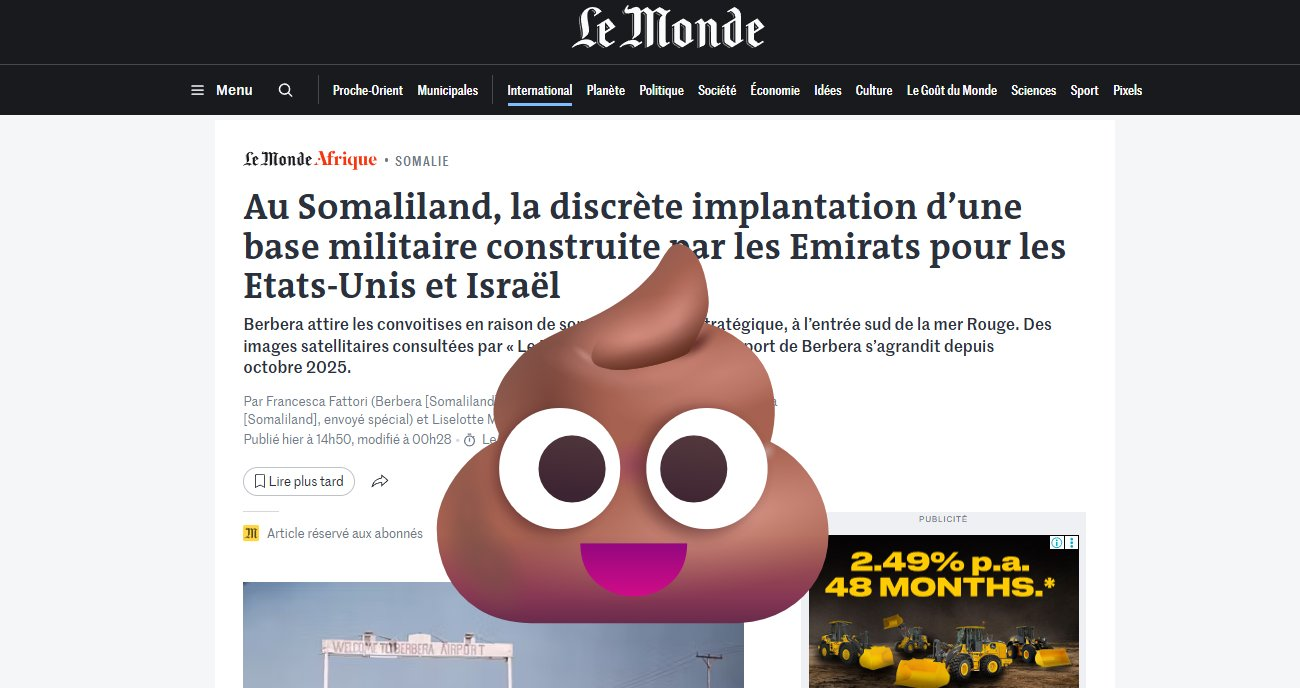
Le Monde's Francesca Fattori, Noé Hochet-Bodin, and Liselotte Mas have written from Berbera as though physical proximity to a place makes fiction factual. It does not. Their latest piece claims Berbera is a secret base for Israel, the UAE, and the United States. At this point, why stop there? Bit unfair to leave out Australia and Japan. Might as well throw in Cambodia while we are at it.
This is not the first time main stream media has peddled unsubstantiated narratives about Somaliland. For over a year, the "Somaliland hosting Palestinians Refugees" story was pushed relentlessly. We said it was nonsense. No apology came. Just a quiet pivot to the next bit of fiction. Standard playbook.
The article jumps into speculation that Berbera "could be used near Yemen" with no hard evidence. The entire basis is geography and tension with the Houthis. Proximity to a conflict zone does not make a port city a forward operating base. By that logic, every coastal facility on the Red Sea corridor is a secret military installation. Djibouti, Aden, Massawa, and Jeddah would all qualify. The article presents a geographic fact as a strategic revelation, which is lazy at best and dishonest at worst.
The piece strips Somaliland of any independent interest in security, trade, or recognition. It treats the country purely as a passive tool for Abu Dhabi, Washington, and Tel Aviv. This framing is not just inaccurate. It is deeply patronising. Somaliland has its own strategic calculus. Berbera port was developed to serve Somaliland's economic ambitions, its trade corridors with Ethiopia, and its long-term bid for international engagement. Reducing that to a proxy narrative erases the agency of an entire nation and its democratically elected government.
The article relies heavily on unnamed "security" and "military" sources while presenting their speculation as settled fact. No validation is offered for the claim that the UAE is currently active in Berbera in any military capacity. There is a significant difference between a commercial port agreement and a covert military operation. Le Monde does not bother to distinguish between the two. When anonymous sourcing replaces verifiable reporting, the result is not journalism. It is narrative laundering.
The piece ignores every alternative explanation for activity at Berbera. Maritime security, anti-piracy operations, broader Red Sea posture, and commercial shipping logistics all provide a straightforward basis for engagement with the port. Instead, the article forces a single Yemen-centric, Iran-centric reading onto the evidence. This framing serves a predetermined editorial conclusion rather than letting the facts lead.
The only truly tangible reporting in the piece is AFRICOM's visit to Berbera. This is well known old news. Yet Le Monde fails to mention the most relevant policy context: under the 2023 National Defense Authorization Act, the United States is legally mandated to engage with and study Somaliland over a five-year period. This is not a secret. It is public law. AFRICOM's engagement with Berbera fits squarely within that congressional mandate. Omitting this transforms a routine, legally grounded visit into something sinister, which is precisely the point of the article.
Somaliland is not a blank canvas for journalists to project geopolitical fan fiction onto. It is a functioning state with democratic institutions, strategic interests, and a population that deserves better than to be reduced to a plot device in someone else's story.