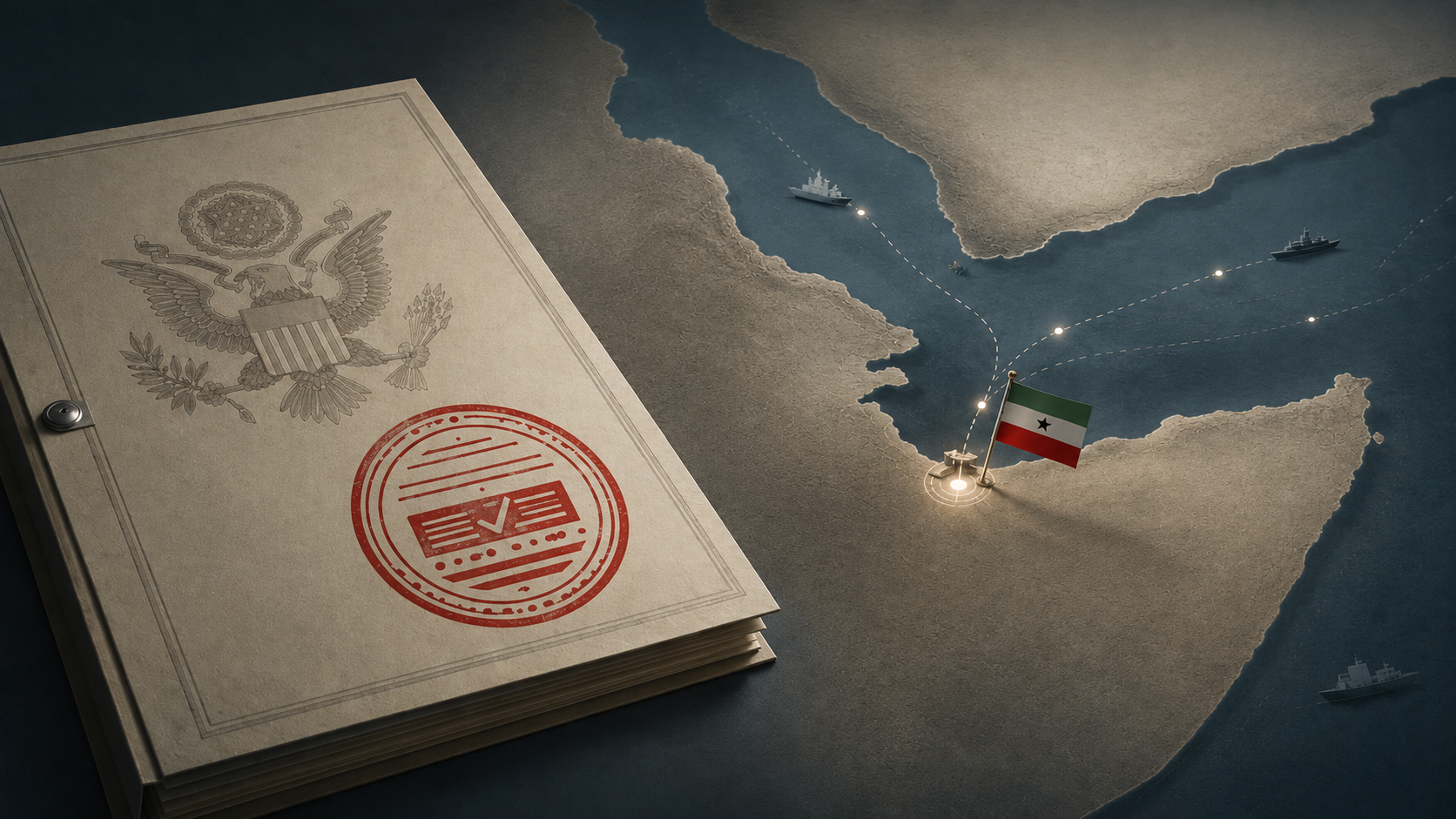
The latest American move on Somaliland is not recognition. It is something more revealing. Washington is now openly studying deeper engagement with Hargeisa while still repeating the old formula about Somalia's sovereignty and territorial integrity.
That contradiction is the story.
In the House report for the 2026 National Security, Department of State, and Related Programs Appropriations Bill, Congress directed the Secretary of State to report on improved United States engagement with Somaliland in security, diplomacy, trade and development. The language was modest, but the premise was not. It accepted that Somaliland is not merely a local administrative question inside Somalia. It is a strategic actor with whom America needs a practical relationship.
Now that the State Department report has surfaced in regional reporting, the pattern is clearer. Washington sees the value. It sees Berbera. It sees the Red Sea. It sees counterterrorism, trade, infrastructure and development. It sees the same facts Somalilanders have spent three decades presenting to the world.
The Signal
The report is a signal wrapped in hesitation. According to coverage of the submitted report, the State Department identified possible cooperation with Somaliland in security, trade, diplomacy and development, while also reaffirming the United States position that Somalia remains the recognised sovereign state.
This is not a neutral bureaucratic line. It is the central weakness of American policy. The United States wants the benefits of engaging Somaliland without accepting the legal and diplomatic reality that makes those benefits durable.
That existing policy is not a law of nature. It is Hillary Clinton's Single Somalia framework, later defended and amplified by Ilhan Omar's Somalia first politics. As I argued in Trump Should Finish the Job and Recognise Somaliland, the blockade became entrenched under the old Clinton era foreign policy machine and is now championed by figures who treat Somaliland's recognition as a threat to Greater Somalia ideology. The deeper history was also laid out in Rubio: Time to Reverse Hillary's Single Somalia Policy.
There is also a moral question here. Somaliland does the work, keeps the peace, secures the coast, runs the elections, protects Berbera and builds the institutions. Then another entity claims the credit because the diplomatic paperwork still says Somalia. Is that American values? Is it American values to take credit for the hard work of another people, another country, another democracy? If Washington believes in fairness, accountability and truth, then it cannot keep allowing Somaliland's achievements to be filed under someone else's name.
It wants a partner, but not a state.
It wants access, but not recognition.
It wants stability, but not the political courage to reward the people who built it.
That is not realism. It is rented realism. It is the same habit I criticised in America, Stop Renting Dictators, except this time the problem is reversed. America is not renting a dictator. It is trying to rent a democracy while withholding the dignity owed to a democracy.
Do Not Overread
This is not America rejecting the rejection of Somaliland recognition. It is not Washington finally deciding the Somaliland question. It is a low level, business as usual procedural aspect of the United States government working through existing facts, existing policy language and existing bureaucratic categories.
Somalilanders should not overreact to it. We should not treat it as if America has reached a final decision on recognition. The higher level signal is elsewhere. What we know from various reports is that President Trump is considering Somaliland recognition, and beyond that, that the United States protected Israel's recognition of Somaliland when the issue reached the United Nations.
That matters more than this report.
The change Somaliland expects will come from the highest level of the United States government, not from procedural bill language. Still, the report creates an opportunity to discuss Somaliland strategy and to ask what happens if nothing follows. That is the purpose of this article. It is not to pretend that a committee report has solved the recognition question.
Berbera Speaks
Berbera is the reason the pretence is collapsing. The port sits near the Gulf of Aden and the Red Sea at a time when shipping lanes, Iranian pressure, Houthi attacks, Chinese expansion and Gulf competition have made maritime geography brutally important again.
This is why Somaliland is now being discussed in Washington as a security and economic partner. Semafor reported in February 2026 that Somaliland was pitching its strategic location and mineral potential to the Trump administration, while noting that DP World has invested more than 400 million dollars in Berbera's expansion. That is not symbolism. That is infrastructure meeting strategy.
The old Somalia policy cannot explain Berbera. It can only obstruct it.
Somalia does not control Berbera. Somalia did not build Somaliland's peace. Somalia did not secure Somaliland's coast. Somalia did not create the political order that made investment possible. Yet the diplomatic fiction still asks Somaliland to remain trapped inside a state whose authority does not reach Hargeisa.
As I argued in Le Monde's Berbera Fiction, Somaliland is not a passive location on someone else's map. It has agency. It has elected governments, a security architecture, a foreign policy and a national interest.
The Blind Spot
The same bill exposes the blind spot inside American thinking. It discusses the Indo Pacific Strategy and countering PRC influence. Somaliland belongs in that conversation because Berbera links the Red Sea, the Gulf of Aden, the Indian Ocean and the wider Indo Pacific commercial system.
It discusses maritime security and supply chain resilience. Somaliland belongs there too. A stable democratic state on one of the world's most important maritime corridors is not a side note. It is part of the answer.
It discusses bilateral economic assistance and the Democracy Fund. Somaliland applies to both. It has elections, political competition, basic state order and a record of surviving without the external support routinely given to weaker states.
It discusses Iran, the Houthis and terrorist proxies. Somaliland applies there as well. A pro Western state on the Gulf of Aden, close to the Red Sea theatre, has obvious value in any strategy that wants to contain Iranian backed pressure on shipping and regional stability.
Yet Somaliland appears narrowly, as a bilateral engagement question, instead of being treated as a cross cutting strategic asset. That is the real failure of the document. It sees Somaliland in one paragraph, then misses Somaliland across the rest of the strategy.
The Old Formula
The territorial integrity argument survives because institutions repeat it, not because it explains reality. The United States can engage Somaliland, depend on Somaliland, consult Somaliland and study Somaliland. Then the same system pretends all of this happens inside a Somalia framework.
This is the diplomatic equivalent of using Somaliland's house while insisting the title deed belongs to a neighbour.
The problem is not international law. The problem is political fear. Somaliland was a separate British protected territory, became independent on 26 June 1960, entered a de facto unity that was never legal, and restored its independence in 1991 after state collapse and mass violence. That history is not secession from a functioning state. It is state continuity after the collapse of an arrangement that never achieved legal union.
That is why the recognition question cannot be treated as a group order, as I argued in State Recognition Is Not a Group Order. A state recognises another state because it judges the facts, interests and law for itself. It does not wait for the slowest committee in the room to discover courage.
The UK Warning
Somaliland has already tried this with the United Kingdom for more than twenty years. It has had parliamentary sympathy, local council motions, visits, development language, consular style access, security conversations and endless friendly words. We know how this ends. We know how limited it is. We know the backstab that follows when a government enjoys Somaliland's cooperation, then retreats behind the same Somalia formula when recognition becomes real.
Somaliland does not need to repeat the UK experience with the United States. It needs the Israeli experience. The difference is not emotional. It is structural. The UK model gives de facto engagement without status. The Israeli model breaks the psychological wall and turns Somaliland from a case to be discussed into a state to be dealt with.
This was explored years ago in Hargeysa Washington Win Win Or No Deal, which separated the UK treatment from direct recognition and the Abraham Accords route.
Conclusion
The latest report should be read as a stage in the collapse of denial. First they said Somaliland did not matter. Then they said Somaliland mattered only as a local Somali issue. Now they admit Somaliland matters to American security, trade and regional strategy.
The final step is recognition.
Somaliland should not mistake engagement for victory. Practical cooperation is useful, but it can also become another waiting room. Washington may want enough relationship to use Somaliland's advantages, but not enough recognition to end Somaliland's vulnerability.
That is why Hargeisa must remain firm. The offer should be clear. Security cooperation, commercial access and diplomatic alignment must lead toward recognition, not replace it. Somaliland is not a subcontractor for failed Somalia policy. It is a democratic state seeking normal status.