Executive Summary
The states participating in the Abraham Accords should turn them into a binding regional framework for resolving the Palestinian question with Egypt, Jordan and the wider Arab world, rather than leave them as a platform for symbolic normalisation.
The recommendation is an enforceable arrangement centred on civilian administration, stability and demilitarisation. Israel's long term security will be stronger when regional agreements narrow the space for conflict and external exploitation. The 11 July 2026 update rejects Rahm Emanuel's 23 state formula as diplomatic arithmetic without a coherent security logic.
Full Text
Israel and Somaliland share the experience of being denied acceptance by neighbours, some of whom have wished them gone. That is why I care about Israel's survival. My position predates the diplomatic convergence between the two countries and rests on justice and realism in international relations.
That understanding does not mean military power can by itself secure lasting peace. Israel is at a crossroads. Force can answer immediate threats, but durable security requires political agreements that reduce the number of active fronts and widen the circle of regional partners.
The Abraham Accords must therefore move beyond symbolism and create a final, binding path towards resolving the Palestinian question. Without a credible settlement, Iran and its proxies retain room to exploit Palestinian suffering in support of their own regional project.
Agreement, Not Aspiration
Abraham Accords V2 cannot be a diplomatic wish list. It needs a structured and enforceable path towards a stable Middle Eastern order rather than another framework for managing recurring wars.
Realism requires acknowledging that sovereign states do not surrender land acquired through force without a meaningful transaction. Condemnation alone does not change borders, which is why the prevailing diplomatic model for Palestinian statehood has failed to turn principle into a workable settlement.
Updated 11 July 2026.
Diplomatic Arithmetic
Rahm Emanuel's 23 state framework, praised and amplified by Hillary Clinton, is one of the dumbest ideas ever seriously proposed as a regional strategy. Its arithmetic is Israel, Palestine and the other 21 members of the Arab League.
That count drags failed states such as Yemen, Somalia and Sudan into a settlement they cannot credibly enforce, while padding the slogan with distant members such as Djibouti, Mauritania and Comoros. Imagine taking the conflict between Eritrea and Ethiopia and marketing a settlement covering the whole African Union as a 55 state solution. A larger number does not create a coherent strategy.
The revealing issue is who falls outside the framework. Somaliland, a leading Muslim partner for coexistence that Israel has already recognised, is absent. Iran and Turkey, Israel's immediate adversaries, are absent too. A plan that counts distant spectators while excluding the partners and adversaries closest to the security contest is not regional statecraft.
After her record in Libya and Afghanistan, and the Single Somalia policy she helped entrench, Hillary Clinton should sit this one out.
Updated 12 July 2026.
Selective Memory
Ro Khanna was born in Philadelphia, but his parents came from India's Punjab region. That history matters because Punjab bore the worst of the 1947 Partition. If the same logic were mechanically applied to Israel and the Arabs, it would demand that every Arab, including Arab citizens of Israel, move to Jordan. That is not coexistence. It is mass population transfer.
Partition displaced about 15 million people and killed an estimated one to two million. Khanna should reflect on the darkness of his own family region's history before presenting easy prescriptions to another society.
The Palestinian question still requires a final settlement, and violence by extremist settlers against Palestinians is barbaric and should be prosecuted. Yet Khanna's recent West Bank account does not mean Israelis are silent. Israeli civil society groups such as B'Tselem and senior Israeli security officials have condemned the same violence. Moral seriousness requires recognising that internal opposition exists, rather than pretending conscience arrives only with visiting Democrats.
The Gaza chronology also exposes selective outrage. More than 46,000 deaths had been reported by 15 January 2025, compared with 73,110 by 8 July 2026. Roughly two thirds of the cumulative reported toll had therefore already occurred before Trump returned to office, not more than 75 per cent. Trump should be judged for what followed, but Democrats cannot erase the catastrophe that unfolded under Biden.
With the midterms approaching, some Democratic politicians appear increasingly willing to lean into anti-Israel sentiment to energise parts of their electoral base. From Hillary to Rahm, and now Ro Khanna, the pattern is becoming difficult to ignore. Instead of serious statecraft, they offer immature, reflexive proposals that make effective campaign messaging but provide no credible path to peace or security. The Palestinian question needs resolution, not selective lectures from Democrats or Tucker Carlson.
Political theatre is not strategy.
Three Responsibilities
After Gaza, it is difficult to assume that placing two fully independent and armed entities side by side will prevent recurring conflict. Imagine granting full sovereignty to an authority that develops along the Hamas or Hezbollah model, with Israeli civilians immediately within its striking range and the powers of statehood at its disposal. After seeing Iran's partners and proxies use territorial control in Gaza, Lebanon and Yemen as a platform for armed pressure, reproducing a Houthi style arrangement beside Israel cannot be called responsible statecraft.
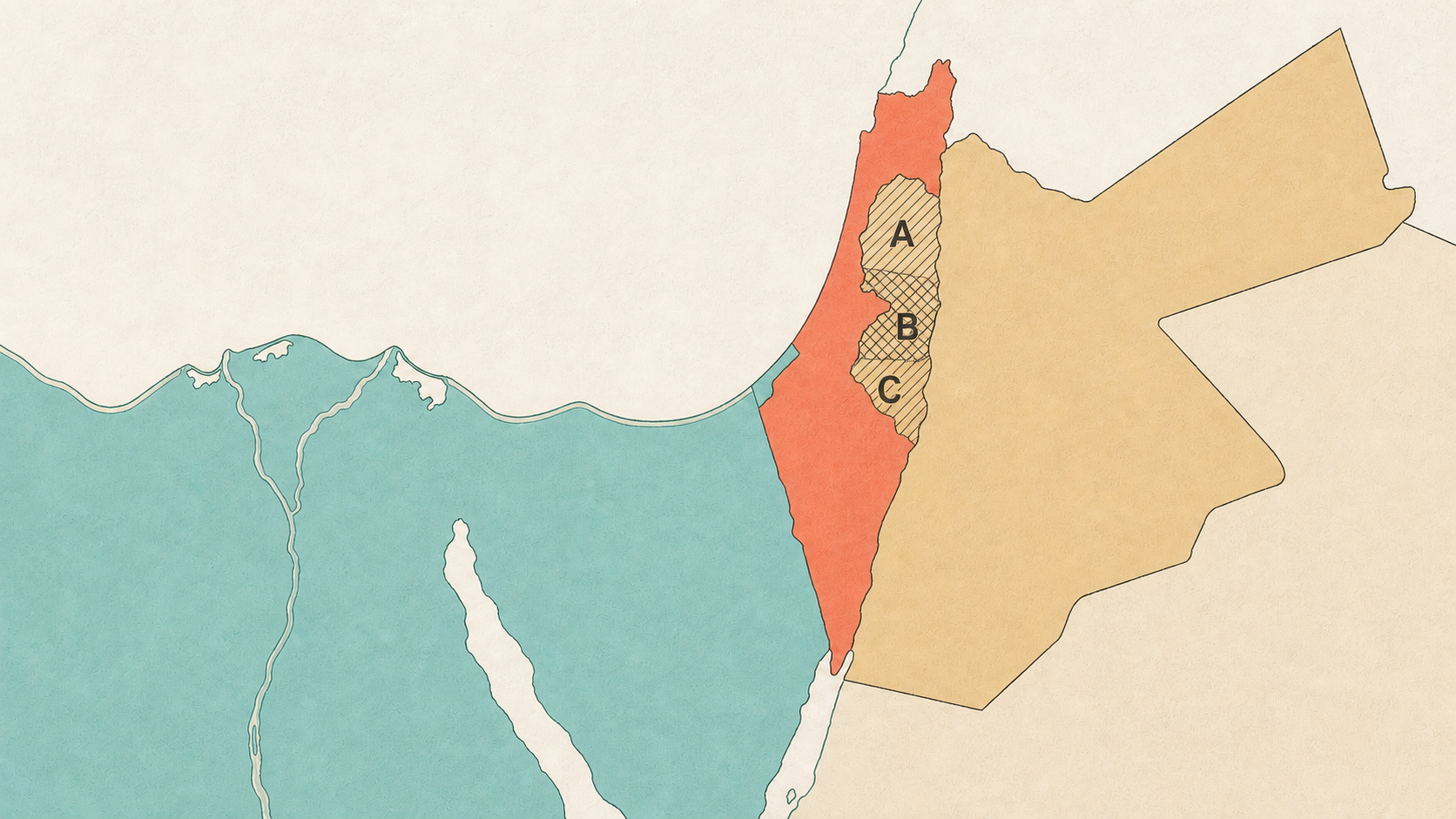
The alternative proposed here assigns three responsibilities. Israel would remain responsible for its own security and government, Egypt would administer Gaza, and Jordan would administer the West Bank.
The Egyptian and Jordanian administrations could operate within a federal arrangement with limited security powers, placing civilian governance and stability before militarisation. Settlements existing at the end of 2025 would remain, with structured relocation options where needed to create more coherent borders. This is not a perfect formula, but an effort to turn the test of sovereignty and security into viable institutions.
Regional Protection
As Jews face rising antisemitism around the world, peace with Israel's immediate neighbours can no longer be deferred. Enforceable agreements with Egypt, Jordan and the wider Arab world would anchor Israel in its own region. That protection would be more durable than reliance on any single American political constituency, since every constituency remains vulnerable to electoral change.
Israel's crossroads does not require another slogan. It requires an agreement that makes its security part of the region's stability.