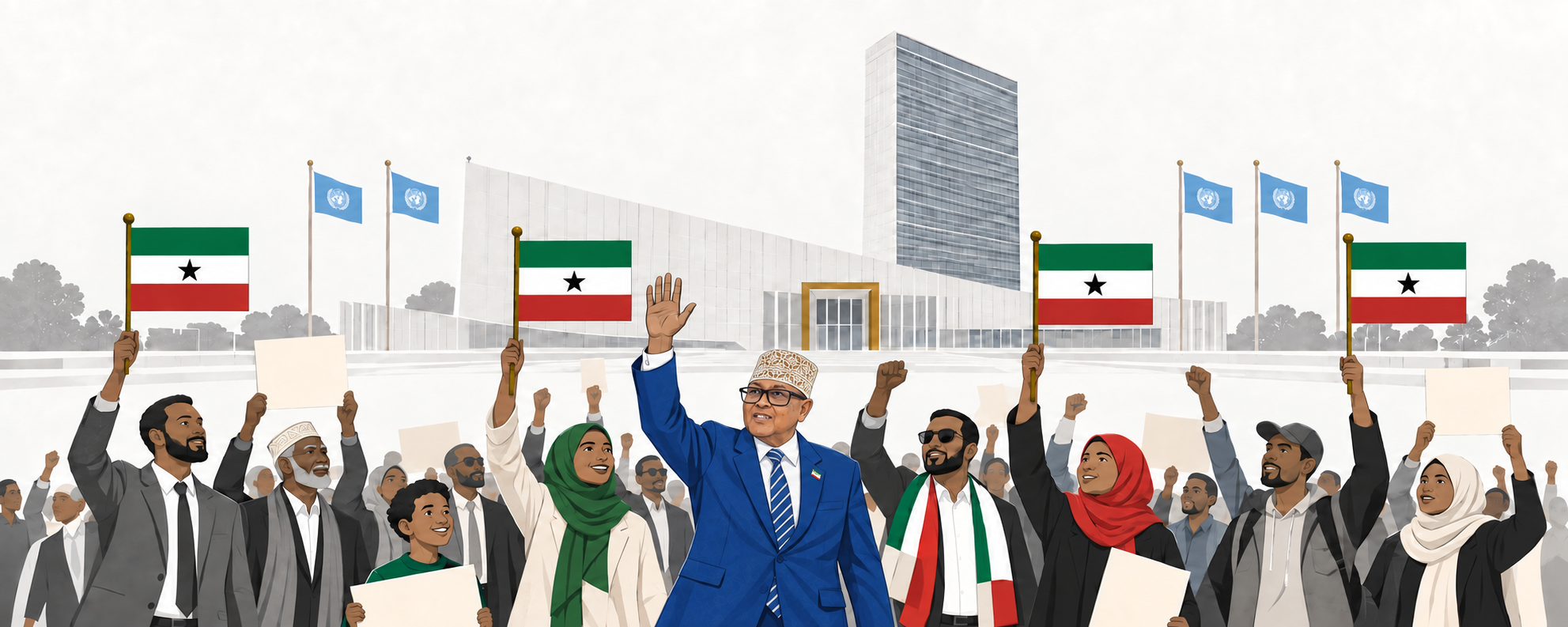
On 23 September, Somalilanders and advocates will rally at Dag Hammarskjöld Plaza outside United Nations headquarters in New York. As President Abdirahman Mohamed Abdullahi Irro takes Somaliland's case to the city, flags outside will reinforce it inside. Their message is not a request for permission to exist. It is a demand to be judged as the country they have built.
That demand rests first on law. Somaliland's case is state continuity, not secession. British Somaliland became independent on 26 June 1960 before a de facto union with the State of Somalia. The attempted union never legally took place as a completed union between two sovereign countries. Somaliland therefore claims prior sovereignty, not a right to leave a functioning parent state.
Legally, the distinction should settle the category. Politically, even if it is called secession for argument's sake, the strategic answer to precedent panic is the Somalia Threshold, a recognition gate for deciding whether another claim is comparable. It is not an open door to secession. It is a locked gate against false comparisons.
The precedent is not Somaliland. The precedent is Somalia.
To become a meaningful precedent elsewhere, another country must cross an extraordinary threshold. Somaliland's foreign ministry should ask foreign ministries and African Union legal advisers four questions. Has the state suffered prolonged collapse, lost effective control and remained institutionally weak? Has another territory maintained a separate political order for years? Without every condition, there is no comparison.
Somalia crossed that threshold after 1991. An official World Bank report describes it as emerging from more than three decades of being considered a failed state. Its data record the limited capacity and reach of successive Mogadishu governments, exposing the gulf between diplomatic claim and actual government control. Under that condition, Somaliland maintained its separate political order.
The strongest objection is that the line can be uncertain. However, that uncertainty does not mean every crisis creates a right to recognition. The threshold does not compel recognition. It disciplines comparison because duration, depth, lost control and institutional separation must appear together. A dissatisfied region or temporary crisis does not meet it. Precedent depends on comparable facts, not a recycled label.
Foreign ministries considering recognition should issue and apply this analysis in every strategic legal brief. They should review the legal category, assess each condition, classify the comparison, publish their evidence and reject unsupported analogies. If they cannot identify similar collapse and durable separate order, political fear is substituting for evidence about state power and interests.
There is also a second injustice, the Somalia Penalty. Somaliland recognition acknowledges completed work, not permission to exist. We already exist. Yet Somaliland is forced to carry Somalia's identity, failures and policy penalties. Those burdens include the reputational costs of terrorism and piracy, exposure to sanctions architecture, financial restrictions and travel warnings written through the Somalia frame. Merging the records distorts security analysis, investor incentives and diplomatic decisions.
Somaliland is not made up of perfect angels. No country is. Six million people should be judged by Somaliland's own record rather than punished for Somalia's. This political injustice is not natural. The international community created it through policy, and one recognition by Israel in 2025 proved that policy can change through recognition.
So when countries fear a supposed Somaliland precedent, they are staring at the wrong side of the equation. Before Somaliland becomes your problem, your state has to become Somalia. If your country is genuinely at risk of crossing that threshold, Somaliland is the least of your problems.