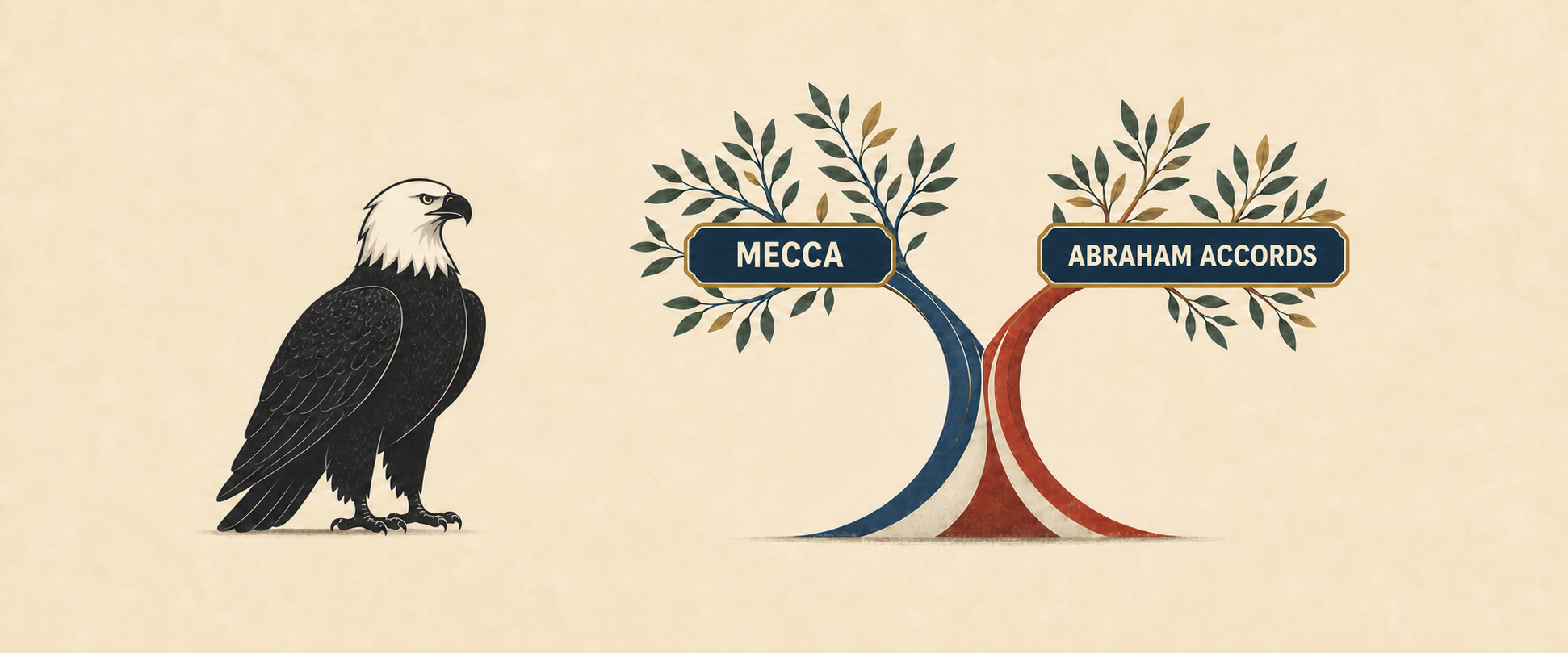
Mecca and the Abraham Accords are two branches of one American alliance strategy. President Trump welcomed the Mecca Joint Defense Agreement between Saudi Arabia, Türkiye and Pakistan, signed on 7 August to combine Saudi financial power, Turkish military capacity and Pakistan's strategic weight. Saudi celebration of his statement, amplified on X by the United States Embassy in Riyadh, gave that welcome diplomatic meaning. The delayed US reaction appears deliberate, allowing regional actors greater agency while Washington delegates responsibility and remains the central power.
The Abraham Accords made normalisation, commerce and state relations one path to regional order; Mecca adds collective defence and burden sharing. Washington should neither force the branches into one institution nor let their rivalry become war. Türkiye's foreign ministry records its recognition of Israel in 1949, showing why separation need not be permanent, since present rivalry leaves room for practical convergence. The branches should compete to produce stability.
The Abraham branch must grow through new members and renewed purpose, as the United States National Security Strategy already calls for expanding the accords. Otherwise it will appear bare while Mecca spreads. Mecca should be judged by operational coordination, deterrence and reduced demands for American intervention, while Abraham should deliver new normalisation, trade and enforceable peace. If either exports conflict into the other, Washington should restrict access rather than reward obstruction.
This is the peaceful competition the Middle East needs. Ending the Iran war requires more American diplomacy, because force created pressure but could not construct a settlement. Mecca gives regional powers security responsibility while Abraham preserves normalisation as the wider destination. In Gaza, Washington can lean on one branch when the other obstructs peace, using endorsement, access and diplomatic momentum as pressure rather than choosing a permanent winner.
Washington should bring Somaliland into the Abraham Accords before the November midterms as a quick foreign policy win. Israel has already recognised Somaliland, and the UAE has built a deep economic partnership around Berbera and DP World. These relationships make Somaliland the natural next member.
Selected functions distributed across American facilities in Saudi Arabia and Qatar could then be assessed for gradual consolidation in Somaliland. Berbera offers Gulf of Aden reach more than 2,000 kilometres from Iran. Strategic diversification would avoid abrupt withdrawal while testing whether Mecca can assume more defence responsibility with less direct American protection.
Somaliland should join the Abraham branch while managing its own Saudi and Turkish relationships, pursuing realistic Arab diplomacy and finding common ground that keeps competition healthy. A country with agency does not merely choose a branch. It helps determine how the whole alliance tree responds to genuine common threats.