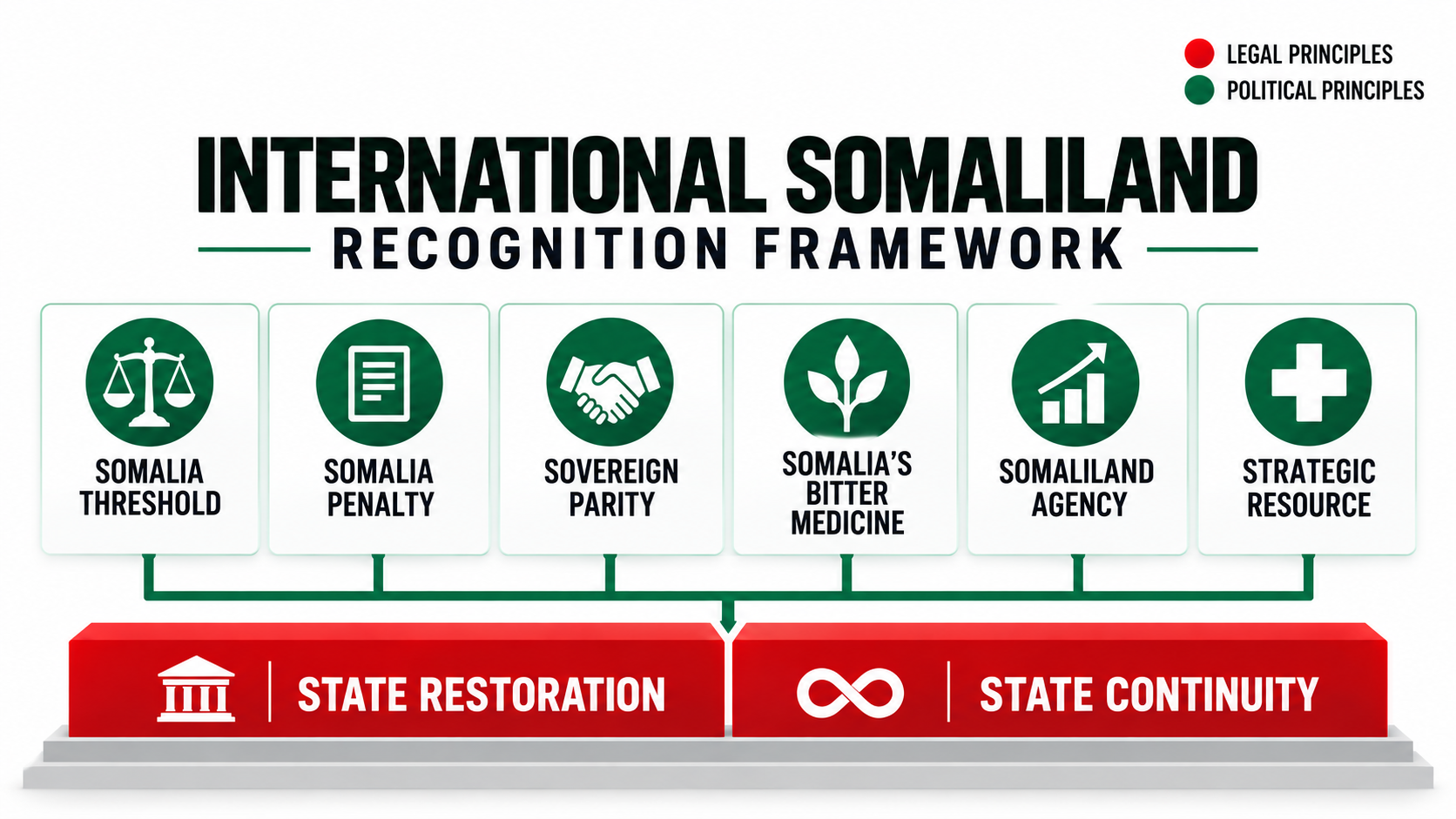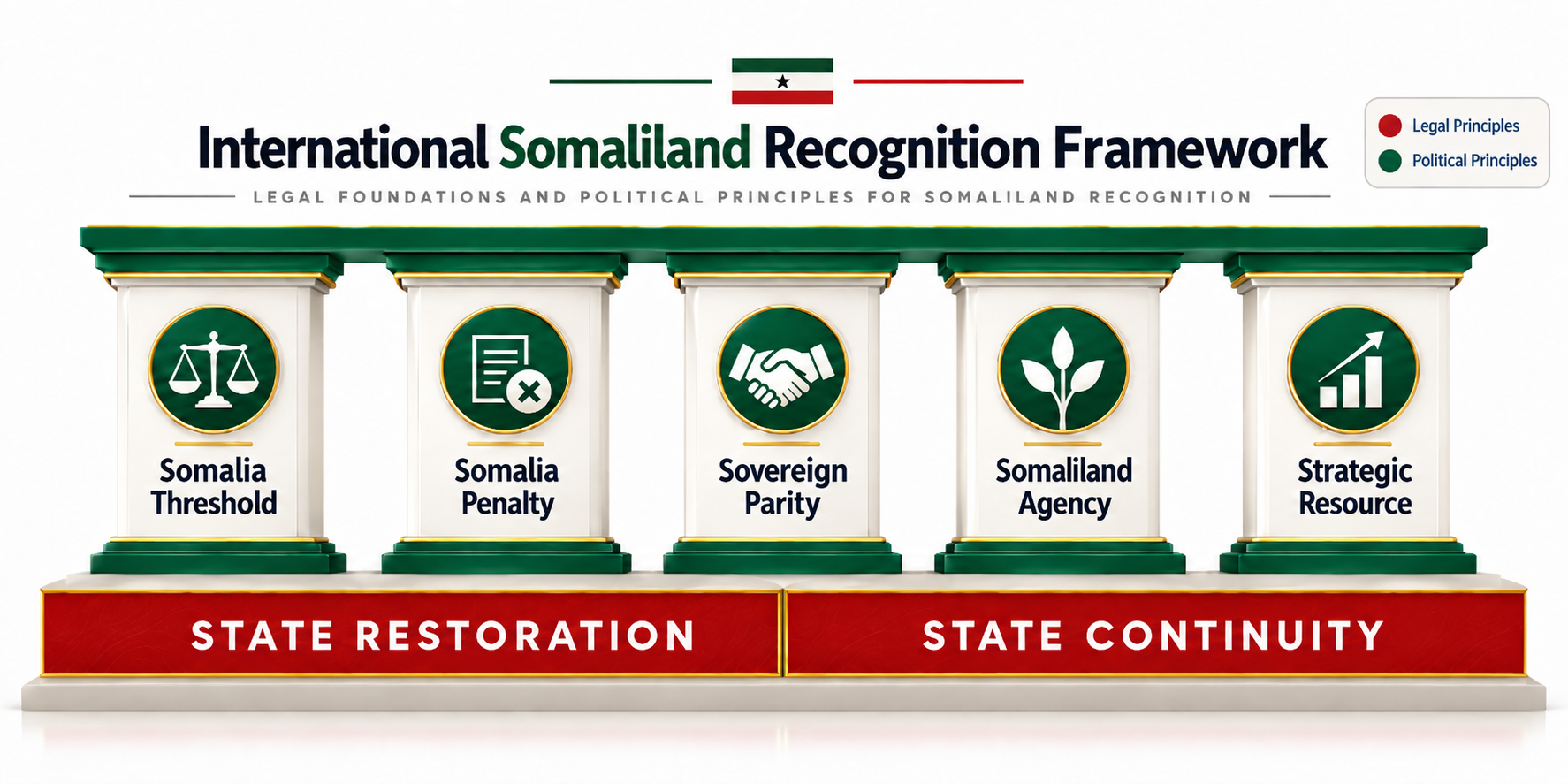
Somaliland's case for recognition has passed through several phases. We began with international law, insisting that we are not a secessionist country. But Somaliland was barely known, and we were making our case to a world that was not listening. The legal argument still needs repeating, because the secession label has not disappeared. Being right about our sovereignty has never been enough to make others pay attention.
We have also developed arguments for individual countries, including the America First Framework for Somaliland re-recognition, the UAE recognition strategy and the case for Ethiopia. That work must continue, because each government needs to understand why recognition serves its own country's interests.
What we have never developed is a global political narrative explaining why Somaliland recognition serves the world's stability. Democracy cannot carry that argument alone, because it is not common political ground for every country. Nor do democracies reliably stand by other democracies, as Somaliland's experience shows. Saying we are democratic or peaceful does not take us far enough. What we have built for ourselves matters, but projecting those achievements onto the world is no substitute for persuading it.
This article supplies that missing global political argument through one worldwide recognition doctrine, with six political principles in front and two legal foundations on demand. Country strategies can apply it to particular interests while keeping a common case for recognition. Politics opens the door; law answers the objection.
The legal reserve is State Restoration and State Continuity. British Somaliland became independent on 26 June 1960, then went into a de facto union with the State of Somalia, which had formerly been administered by Italy. That attempted union between two sovereign countries never legally took place as a completed union. Restoration explains 1991, while continuity explains why Somaliland's sovereignty did not begin again that year.
1. Somalia Threshold
For argument's sake, call it secession. Then apply the Somalia Threshold. A comparable case requires prolonged state collapse, lost control, deep institutional failure and a territory that has maintained a separate political order for decades. A temporary crisis satisfies none of that.
Foreign ministries and African Union legal advisers should test all four conditions whenever they hear the precedent objection. The threshold exposes false comparisons without compelling recognition. The precedent is not Somaliland. The precedent is Somalia. Before Somaliland becomes your problem, your state has to become Somalia. If that is your trajectory, Somaliland is the least of your problems.
2. Somalia Penalty
Recognition is not permission to exist. We already exist. Yet Somaliland carries Somalia's identity, failures and penalties through terrorism and piracy stigma, sanctions exposure, financial restrictions and travel warnings. International policy merges two records, then punishes the better one.
Somaliland is not made up of perfect angels. But six million people should be judged by Somaliland's record, not punished for Somalia's. Governments should require separate Somaliland assessments for financial compliance, travel advice, security risk and investment. Regulators should identify the institution and territory that created each risk instead of using Somalia as the automatic proxy. This is no natural disaster. International policy created this injustice, and international policy can end it.
3. Sovereign Parity
The Sovereign Parity Doctrine sets the terms of engagement. A mediator must recognise Somaliland and Somalia as sovereign states, or recognise neither. Recognising Somalia while denying Somaliland's sovereignty endorses one party's claim before talks begin. That is not neutral mediation. It is a verdict disguised as a venue.
Hargeisa should test every invitation against the mediator's recognition policy, the status assigned to each party and the purpose of the agenda. Parity does not prevent talks. It protects peaceful coexistence from becoming diplomatic containment. Somaliland's wider recognition belongs to its relations with the international community. Mogadishu has no veto.
4. Somalia's Bitter Medicine
Somaliland recognition is bitter medicine for Somalia. International recognition gives Somalia legal personality, but foreign policy wrongly inflates that status into proof of Mogadishu's authority over Somaliland. Somalia borrows Somaliland's territory, institutions and population on paper to look more sovereign than it is in practice. Recognition would end that accounting trick and measure Somalia by the state it has actually built.
That correction would force Somalia's political class to stop trying to use its northern claim as a substitute for defeating Al Shabaab, reconciling federal actors, settling constitutional authority and building legitimate institutions. A flag, embassies and a United Nations seat would no longer conceal the difference between legal personality and effective statehood, forcing Somalia to face the work of becoming sovereign in fact as well as law.
Puntland and Jubaland cannot claim Somaliland as a precedent. They are products of Somalia's post 1991 federal order. Somaliland's claim begins with separate British colonial borders, independence on 26 June 1960 and state continuity after a legally incomplete de facto union between two sovereign countries. Federal member states cannot inherit that history by analogy. Recognition would clarify Somalia's constitutional task and strengthen Mogadishu's basis for negotiating authority with its federal actors, not give them an exit.
5. Somaliland Agency
How does recognition help against the Houthi threat and piracy? It turns the southern shore of the Gulf of Aden into a self financing maritime security asset instead of a permanent international burden. Recognition opens the investment, finance and security agreements through which Somaliland can build the coastguard and infrastructure needed to secure its waters.
Recognition cannot defeat missiles or equip patrol boats by itself. Partners must pair it with maritime cooperation, coastguard development, information sharing and commercial investment. The goal is not foreign fleets patrolling Somaliland's coast forever. It is Somaliland securing its side of one of the world's most important shipping lanes.
Zero dollars, zero armies. Somaliland demands no foreign subsidy or troop deployment as the price of recognition. Investment earns returns while security partnerships build local capability. We are not Somalia. We are not Djibouti. When we say a partner, we mean it. Somaliland Agency is the best security deal because responsibility remains with Somaliland.
6. Strategic Resource
Somaliland should treat its strategic location as resource rich countries treat natural resources. Open to all. Free to none. Hargeisa should invite competing proposals and require transparent value, security screening, local capability and reciprocal political commitment. Openness means competition under Somaliland's rules, not indiscriminate access or brown colonisation.
Somaliland gave Washington the buyer's advantage by presenting the United States as Berbera's only serious customer. Exclusive access without recognition rewards delay because a presumed reservation has little market value. One buyer means one price. Strategic geography must create Somaliland's leverage, not someone else's permanent reservation.
Conclusion
Somaliland's presidency and foreign ministry should adopt this framework as a common starting point for recognition doctrine. Every mission should lead with the same six political principles, adapted to each country's interests without changing the worldwide argument. The legal foundations should remain in the brief as reference material and move forward only when a legal objection requires them. Potential partners should answer principle by principle instead of hiding political refusal behind generic language about territorial integrity.
A recognising government can then assess Somaliland separately, stop crediting Mogadishu with authority it does not exercise, establish direct diplomatic channels, negotiate investment and maritime security agreements, and treat future talks according to sovereign parity. Recognition becomes policy when it corrects distorted incentives and unlocks state capacity in both countries.
The framework asks policy to catch up with a state already built. Recognise Somaliland, then let Somaliland do the work.
Arguments must be memorable as well as logical. I have coined these terms to make the ideas easy to recall, repeat and use. I hope the Somaliland community takes up both the arguments and their names, or comes up with better ones. We need a shared language as much as a shared narrative.
I do not claim that this framework is perfect or final. I welcome stronger arguments, better narratives and contributions that help it evolve, including adding pillars or removing those that do not work. We should test it with our friends and allies, whose fresh eyes can show us how it reads outside our own community. Let us find out together which arguments and which words persuade the people we need to reach.